
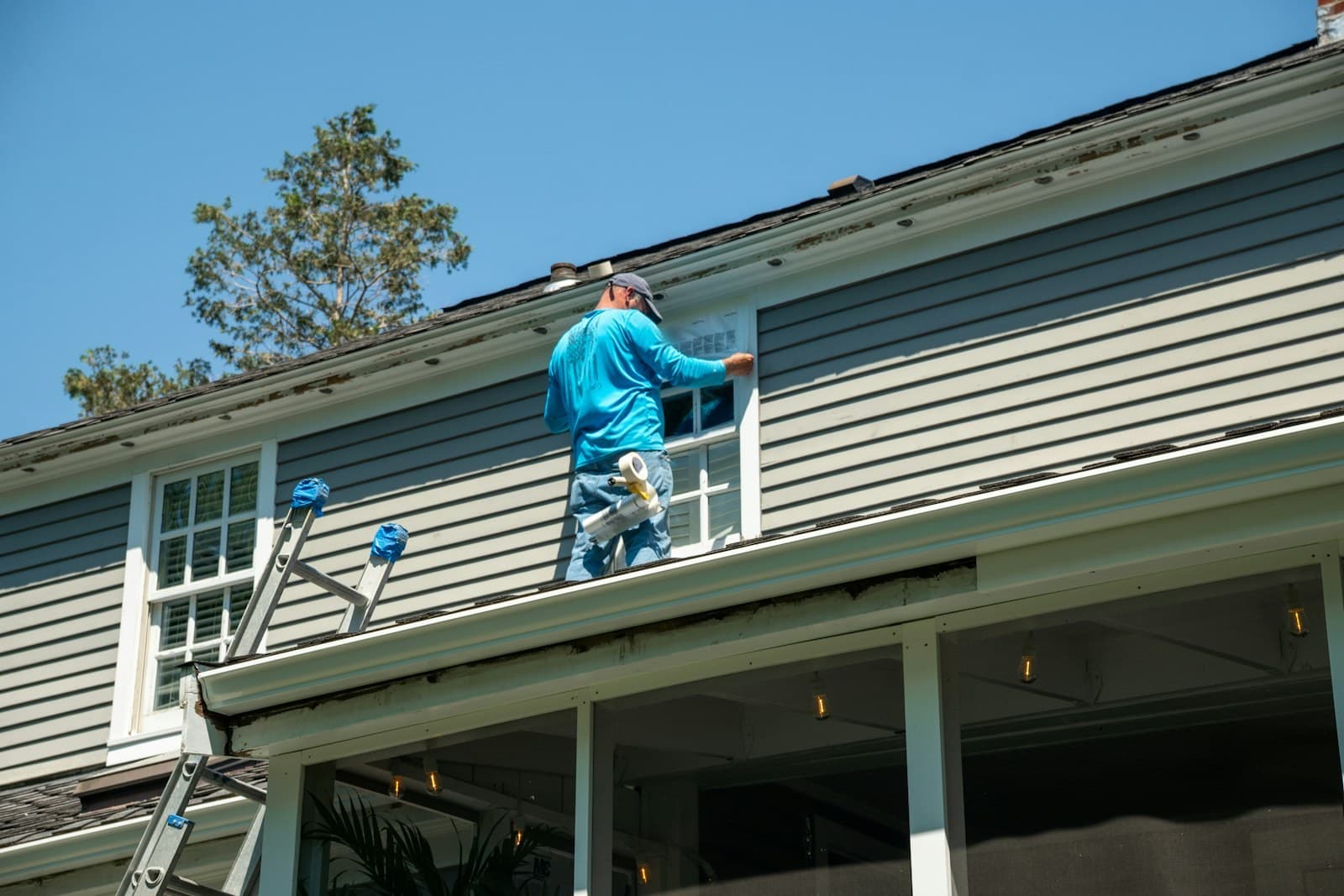
Your estimator leaves a quote for double-hung windows and fiber cement siding on a kitchen table in Cincinnati and drives off. The FTC tells homeowners to get multiple estimates,[1] so yours may be one of several.
That page also tells them to confirm the license with the state or county, ask for proof of insurance and read reviews critically.[1] You can publish most of that before anyone asks. Our local SEO checklist for home service companies covers the rest of what buyers see.
What does siding and window SEO need to prove?
It has to prove what a homeowner can check without you in the room. Here's the inventory I'd fill in for a Cincinnati company that installs siding and windows.
Proof inventory for a Cincinnati exterior company
- License and insurance. Footer and About page: the license number and issuing office, if one applies to your work, and who sends proof of insurance.
- Lead-safe status. Window page, siding page and footer: your certification as written on the certificate, with a link to EPA's firm locator.
- Product lines and warranty. One page per product: the line as the maker spells it, the warranty terms in words, and the month you checked.
- Finished jobs. One page per job: town, what was replaced, product line, month finished, captioned photos.
- Reviews. On the Google profile, and beside the matching job page with the customer's OK, quoted as written.
- Google profile. A primary category for the main trade, an additional one for the second, services under each.
Illustrative example
Then run the search the FTC suggests to homeowners: your company name plus words like "review" and "complaint."[1] Read the first page as a stranger would, and note which of those lines it already answers.
What should your site say about your license and insurance?
Show your license number and the office that issued it, if your work needs one, and say who sends proof of insurance. The FTC says a contract should carry the license number, so use the same one everywhere.[1]
Put the number in the footer beside the company name, spelled as the licensing office has it.
What should you say about lead-safe work in older houses?
Say you're a lead-safe certified firm only if you are, and keep the claim current. EPA says about three-quarters of US homes built before 1978 still contain some lead-based paint.[2]
In general, EPA says, anyone paid to disturb paint in those homes must be certified.[2] Its contractor page adds that firms can't advertise covered work without certification.[3]
Our pages for siding contractors and window and door companies say what the rule requires. What's left is upkeep:
- Renewal. Certifications last five years. EPA says to apply to renew at least 90 days before the end date.[4]
- Changes. A change of name or address has to be added to the certification within 90 days, or the firm isn't authorized to perform renovations until it is. Keep the name on your site the same as the one on your certificate.[4]
EPA recommends that homeowners hire a certified firm for work in a pre-1978 home,[5] and its locator is built for finding one.[6] Link to it where you state yours. Some states run their own program instead of EPA's, so check yours.[4]
EPA's list of covered work is partial: it names remodeling, carpentry and window replacement, not siding. Its general test is any work that disturbs paint in an older home.[3] For a siding job, ask EPA or your state; this isn't legal advice.
How do you show product lines and warranties?
In plain text on each product's page, named the way the maker spells them, with the month you last checked.
For the warranty, say whose it is, what it covers, for how long and how a claim starts. Link the maker's terms for the maker's part, and write yours yourself.
Where a badge carries the proof, put the same words beside it. Google says it works out what a picture shows from the page's text, captions and alt text, plus its own image analysis.[7]
What does a good finished-project page say?
Say where the job was, what was replaced and with which product line. Say when it finished, and what you found when the old siding or windows came off, like rotted sheathing or missing flashing. Put a real photo beside each fact.
Google's guidance on helpful content asks whether a page shows first-hand expertise, from having actually used a product or service.[8] A job page is where yours shows.
Our kitchen and bath post has a project-page skeleton for interiors, and how to photograph a job covers the shots. For exteriors, add the product line and color the homeowner chose, and name the town, not the street.
Do reviews have to name the siding or the windows?
No, and you can't ask customers to. Google says merchants shouldn't request that specific content be included in a review.[9] A review names the job only when the customer chooses to.
Name the job in your reply and on the job page. The request scripts in how to ask for Google reviews stay inside Google's rule: they thank the customer and ask for an honest review, nothing about what to say.
Then count. Open your last twenty reviews and mark the ones that say what was replaced. That shows how much of your proof the reviews carry, and how much your own pages must.
On your own pages, the FTC says a business that posts testimonials could be liable if they're fake or false.[10] It adds that non-representative reviews in marketing could be deceptive.[10] Quote customers exactly, with their OK, and don't present the five best as all of them.
What should your Google profile list for each trade?
Pick a primary category for the trade that brings in most of your work. Google says to choose a specific category from its list, and that you can't create your own.[11]
Add a second category only if you really do that trade, since Google says not to pick one for every product or service.[11] Then list each job as a service under its category. Google's services editor can group them that way, where your profile has it.[12]
Setting your service area and the 20-minute profile check cover the rest, and a local search audit shows how you compare with the companies above you. Type "siding" and "window" into the category box, read what Google offers, and use the same two trade names in your site's menu.
Where do AI assistants fit?
On top of the same pages and profiles. Google says there are no additional requirements to appear in AI Overviews or AI Mode.[13] The basics it lists include important content in text and an up-to-date Business Profile.[13] How to show up in Google's AI answers goes through the rest. To see what the assistants say about you today, run an AI search audit yourself.
One 2026 study counted local AI citations across ChatGPT and Google's AI features together, and it's a single study:
Business websites supply 42% of the ~1.97M citations in local AI answers (ChatGPT, Google AI Mode, AI Overviews); Google Business Profile ~29%.
Source: BrightLocal local AI visibility study · (opens in a new tab)
Check that each proof in the inventory is on its page as text, not only in an image.
What proof should you leave off?
- A credential you can't show. If you can't hand a homeowner the paper, leave it off. For bylines, Google's guidance on helpful content calls false credentials a form of deception that makes a page untrustworthy.[8]
- Maker copy pasted onto your pages. Google's guidance asks whether content that draws on other sources avoids simply copying or rewriting them and adds original value.[8]
When is help worth paying for?
You can do most of this yourself, one proof a week. It stops being worth your evenings when the weeks keep slipping behind jobs.
For a second pair of eyes, there's the Free AI visibility check. It's a review by hand of your website and Google profile, with the first fixes, usually within two business days.
The Expert Action Plan ($149) is the Complete Visibility Report plus a 30-minute consultation, for owners who'll make the fixes themselves. The Found Sprint ($1,500 fixed) is up to 10 fixes from the report, done within 30 days once we have access and an agreed scope, with one round of revisions.
Where this stops helping
No page books a job. Proof helps a homeowner who's already looking at you, and it can't make anyone look. Demand moves with the season, the economy and your price, and a license number changes none of them.
Google says meeting every requirement doesn't mean it will crawl, index or serve a page.[13] An assistant can still name someone else: Google says the responses and links its AI features show will vary.[13]
Proof has to be true, and it has to stay true. I'd rather show no certificate than a lapsed one. The government and help pages cited here were checked on October 15, 2026, and rules change, so reread them before you act.