
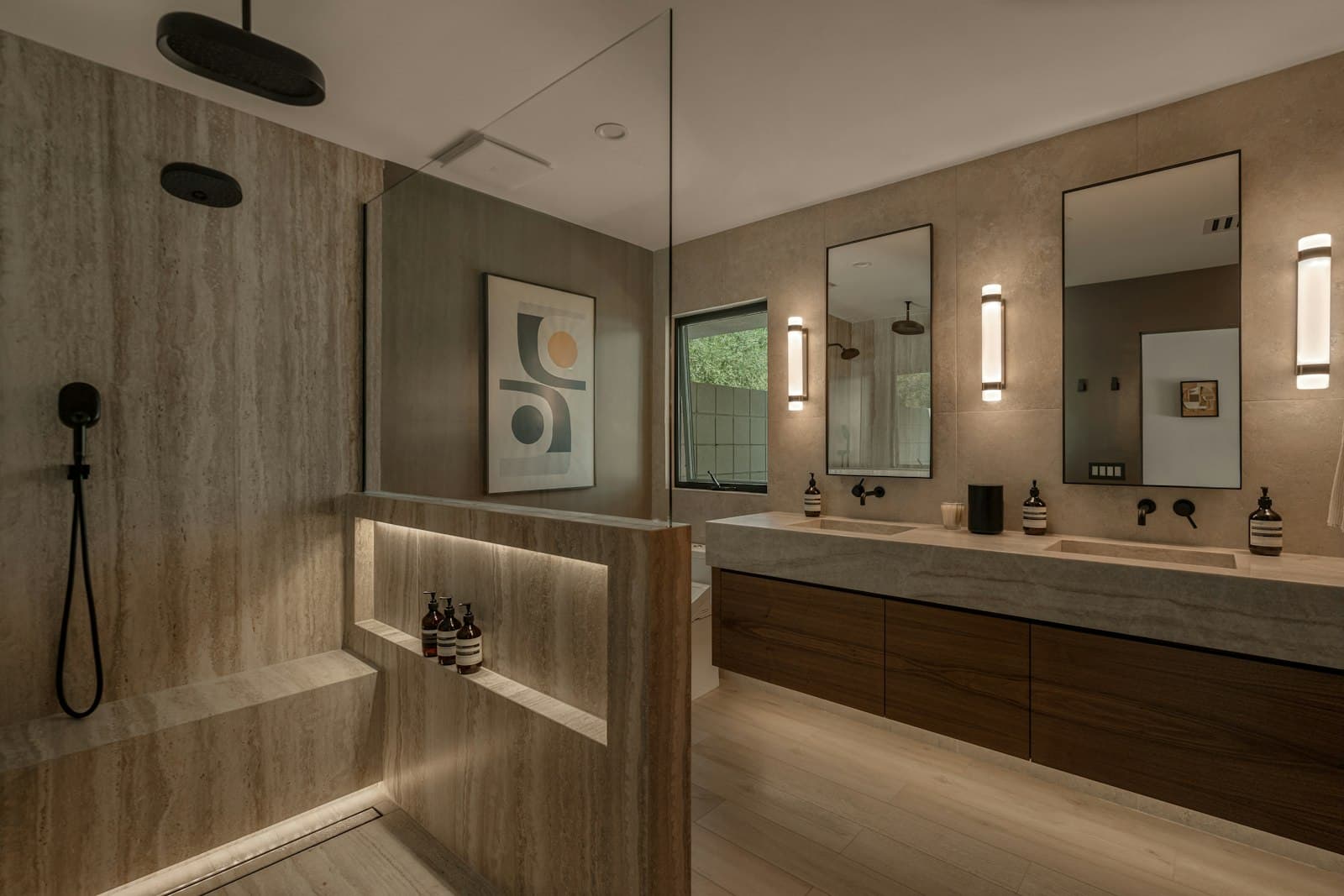
Picture a homeowner in Tampa with a 1980s hall bath and a tub nobody uses. Her mother moves in next spring. Before calling anyone, she asks ChatGPT what a walk-in shower costs, whether she needs a permit, and who does this work nearby.
Only the last question asks for a company. How AI assistants pick local companies covers the mechanics, and our page for bathroom remodelers lists what each page should show. This post adds which questions can name you, and how to word a page so it can be quoted.
Which questions does a homeowner bring to AI before a bathroom remodel?
Seven questions a Tampa homeowner might ask
- What does a bathroom remodel cost in Tampa?
- How long will we be without the bathroom?
- Do I need a permit for a bathroom remodel?
- Can my tub be turned into a walk-in shower?
- Can you build a curbless shower with grab bars for my mother?
- What waterproofing goes behind shower tile?
- Who are good bathroom remodelers near me?
Illustrative example
She may never type the town. OpenAI says ChatGPT may search the web on its own when a question benefits from current information.[1] It may also use an approximate location from the IP address.[1]
Write your own seven from last month's calls and estimate notes, in the homeowner's words.
Which of those questions can put a company's name in the answer?
The "who" question asks for names by design. Questions about one job, like a tub conversion, sit a step from hiring, so with a town in them an answer can name companies. Cost, timing, permits and waterproofing ask for information, so an answer can cite pages without recommending anyone. That's my read, not a measurement.
Google says AI Overviews and AI Mode may run several related searches for one answer,[2] which can widen the set of pages an answer links. It also says a Business Profile can help your services show in its AI responses.[3]
| Question | Names a company? | Page that answers it |
|---|---|---|
| Cost | Less likely | A cost page per project type |
| Timeline | Less likely | Each project page |
| Permits | Less likely | A permits section: who pulls it |
| Tub to shower | Can, with a town | A conversion page |
| Curbless shower, grab bars | Can, with a town | An accessible-bathroom page |
| Waterproofing | Less likely | A how-we-build section |
| Who's good near me | Yes: it asks for names | Your Google profile and reviews |
One study found AI answers named a tracked local business less often than Google Maps did:
In BrightLocal's study of 200k+ localized AI searches, Google Maps named a tracked business in 66% of searches; ChatGPT, AI Mode and AI Overviews named it in only 32–38%.
Source: BrightLocal local AI visibility study · (opens in a new tab)
For the last row, I'd start with your Google profile and reviews, which Ask Maps reads too. Any other row with no page on your site is the next page to write.
How do you write a cost answer an assistant can quote?
Put the answer in the first two lines: a range for one project type, the month you checked it, and what moves it. The same study found business websites, yours and your rivals', supply a big share of what local AI answers cite:
Business websites supply 42% of the ~1.97M citations in local AI answers (ChatGPT, Google AI Mode, AI Overviews); Google Business Profile ~29%.
Source: BrightLocal local AI visibility study · (opens in a new tab)
Our kitchen and bath remodeling post has the project-page skeleton. On top of it, write a sentence that makes sense lifted out alone: project, town and factors together. Google's guide says you don't need to write a special way for its AI features,[3] so write it for the homeowner.
The first lines of a Tampa cost page
- Heading: What a hall bathroom remodel costs in Tampa.
- First lines: your range for a Tampa hall-bath remodel, and the month you checked it.
- Next, a sentence that works alone: Four things move the cost of a Tampa hall-bath remodel: moving the toilet or drain, a tub or a walk-in shower, tile height, and what we find under the old tub.
Illustrative example
Take the factors from your own jobs. The same guide says it can help to have a unique viewpoint that stands out, like a first-hand review.[3] Keep the invoices behind the range in one folder: the FTC says advertisers need proof before an ad runs, and lists price among the claims that matter.[4]
What should the page say about timing, permits and who does which part?
Four things, in plain words: how long the room is out of use, who pulls the permit, which licensed trades do what, and the homeowner's part.
- Timeline by phase: demo, rough plumbing and electrical, inspection, waterproofing, tile, glass, walkthrough. Then what delays it: special-order glass, a failed inspection, rot found at demo.
- What you handle: the permit, the inspections, a licensed plumber for drain moves, a licensed electrician for new circuits.
- What the homeowner handles: picking tile and fixtures by a set date, clearing the room, a plan for a second bathroom.
Florida's contracting law counts someone who remodels a building for others, for pay, as a contractor when the work is substantially similar to a contractor type it defines, with some exemptions.[5] Plumbing contractors are their own category.[5] The law also puts the contractor's license number on each building permit application, and in each advertisement, regardless of medium, as defined by board rule.[6] So name your license on the page, and your plumber's. Other states differ, so check yours.
For the curbless shower, say what you install and whether you've built one, with photos. Skip promises like preventing falls: the FTC says that in most cases, safety claims need competent and reliable scientific evidence.[4] How to write a service page has the full page order.
Which facts can a buyer and an assistant both check?
Beyond the license, two matter most for a bathroom: lead-safe status and what's behind the tile. Our siding and window proof post covers lead-safe work in depth, plus insurance, warranty and finished jobs.
- Lead-safe work. In homes built before 1978, EPA says remodeling, plumbing and electrical work that disturbs paint is generally covered.[7] Firms can't advertise or perform it without certification.[7] If you hold it, say so on each bathroom page.
- What's behind the tile. For each finished bathroom, a photo of the waterproofing before the tile went on, with the town and month. It answers your map's waterproofing row. Photographing your jobs covers the shots.
What should a bath remodeler leave off the site?
- A calculator that prints one price for everyone. A gut remodel in a 1960s house and a tub swap in a new build don't cost the same, and no invoice backs one number for both.
- AI-written city pages. Thirty AI-written bathroom pages that differ only by town name can fall under Google's spam policies as scaled content abuse or doorway abuse.[8] When city pages help has a test.
- Reviews asked only from happy customers. Google doesn't allow businesses to selectively solicit positive reviews,[9] and FTC staff say it could violate the FTC Act.[10] Ask everyone the same way.
How can you see which pages the answers cite, in 20 minutes?
Ask three questions from your map in ChatGPT and Google, with your town in them, and write down every page each answer cites.
- Pick the "who" question plus cost and tub-to-shower.
- In ChatGPT, use a new chat for each and open Sources, when available. OpenAI says that if memory is on, ChatGPT may use saved memories when it rewrites a search,[1] so note whether yours is on.
- In Google, search the same words. If no AI answer shows, write "none shown" for that question.
- Note the date, the companies named and each cited page: yours, a rival's or a directory.
- Circle each question where a rival's page is cited and you have none.
That's one dated sample. For ten questions and repeat runs, use our AI search audit worksheet.
The Free AI visibility check is a review by hand of your website and Google profile, with the first fixes, usually within two business days. The Expert Action Plan ($149) is the Complete Visibility Report plus a 30-minute consultation. The Found Sprint ($1,500 fixed) is up to 10 fixes from the report, done within 30 days once we have access and an agreed scope. Our AI search optimization plans run the same buyer questions across the AI assistants we test (currently ChatGPT, Claude and Perplexity) every month.
Where does an answer page stop helping?
It earns a chance to be cited, not a place in the answer. OpenAI says placement in ChatGPT search isn't guaranteed,[1] and Google says AI Mode and AI Overviews may use different models, so their answers and links vary.[2] Your cost page can be cited for the Tampa cost question while the "who" answer names three other remodelers.
A page also can't make up for three reviews from 2022. These pages were checked on October 18, 2026, and platforms change them, so reread the ones you act on.